Euro Romantic Dreamer
An Aesthetic Origin Story

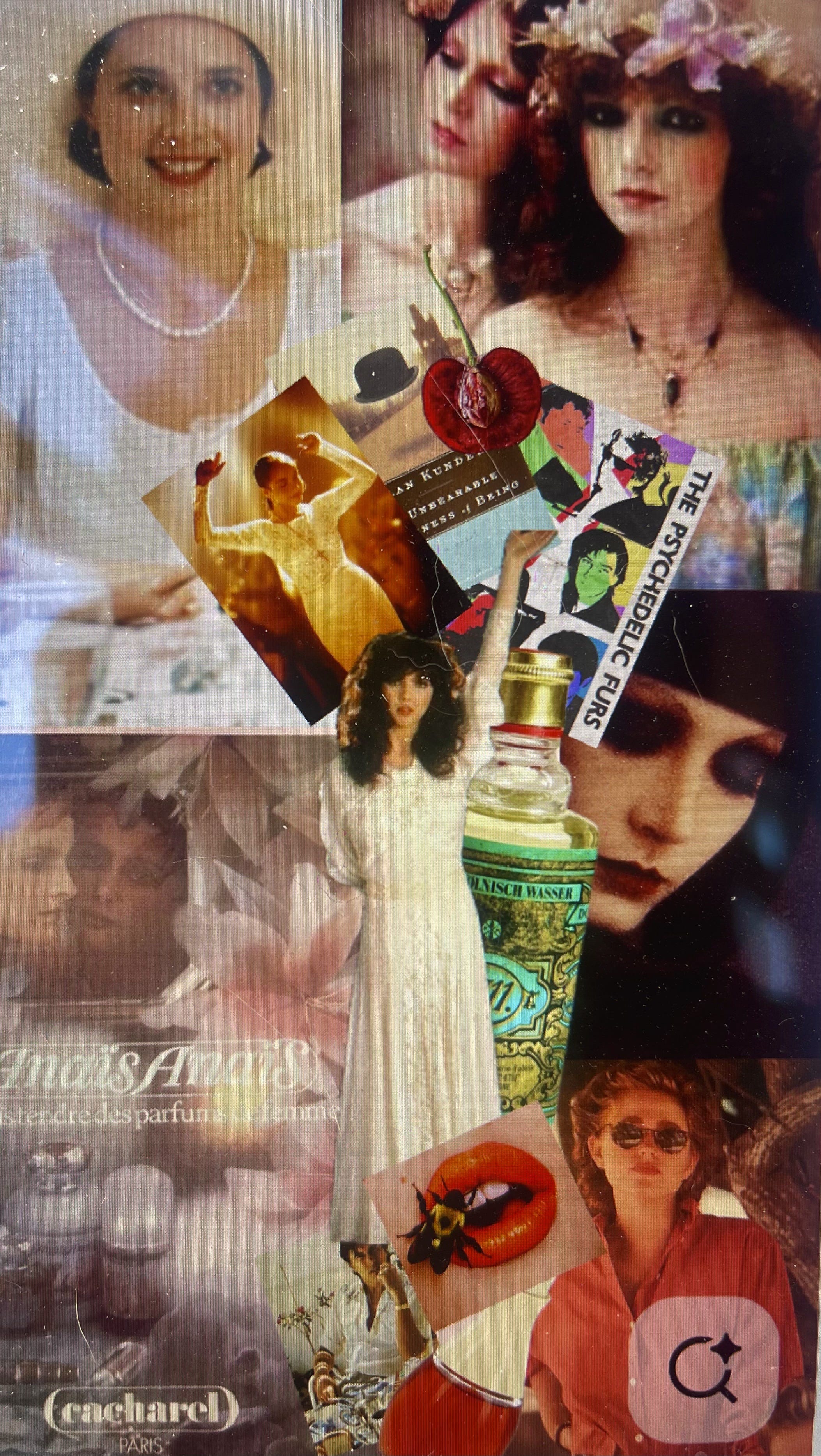
You met her briefly. She is the one I assembled from scent, catalogs, cousins and calibration.
She is the Tweeds catalog, personified. The woman who taught me the word aubergine before the internet, before Google, when a word could take weeks to land. I must have known it meant plum, but plum felt American somehow. Aubergine had shadows. Aubergine suggested dinner tables and lowered voices, a color you arrived at rather than chose. I remember asking around, trying to understand how aubergine became eggplant. I grew up speaking two languages: my mother’s Castilian Spanish and my Wheaton, Maryland English. Meaning was always contextual. Things were allowed more than one name.
Even before the Tweeds catalog, I had glimpsed her. She was a young woman I recognized instantly—a version of my Spanish cousins. She always smelled softly clean, like blossoms from a citrus tree. She wore pressed linen shirts and espadrilles, sun-kissed skin and effortless hair, combed into place wet and left untouched to air dry.
More than once in Spain, I arrived at a party in a cleavage-revealing floral dress, certain I had done something right. Maybe the boys noticed. I got attention. But the other girls were dressed simply—capri pants, linen tops, signet rings, Rolex or Cartier watches worn without comment. They looked calm. Certain. I felt like a throbbing sore thumb.
Back in the U.S., I haunted thrift stores for capris. I sat at my particle-board French provincial vanity and dabbed Anaïs Anaïs at the nape of my neck, trying to learn the difference between being looked at and belonging.
I remember seeing Sade on MTV—hair slicked back into a ponytail, a precise red lip, no other makeup. Her voice was smoky and contained. Your Love Is King felt like the same language my cousins spoke—elegance without explanation, sensuality without urgency. Bryan Ferry’s Slave to Love landed the same way: cool, coy, European in its restraint. The music didn’t reach for you. It waited.
American music felt rude to me then like elbows and insistence. I came to love Bruce Springsteen eventually (ironically, thanks to an Italian cousin), but that came later. At the time, I was still learning how to listen for softness, for control, for a kind of beauty that didn’t announce itself. Also, I listened to Edith Piaf and Peggy Lee, forever one foot in another era.
I began to see how I could be the wrong thing in both cultures while still being recognizably myself. In Spain, when I was fed up or couldn’t feel my whole self, I calibrated toward rude American. Back home, there was a definite intention to be Spanish. I wanted all my oddness—my seriousness, my restraint, my longing—to fit somewhere. Euro Romantic Dreamer became that container.
At fifteen, I got a job at Woodward & Lothrop—Woodies—and suddenly I had more access to clothes and scent. Around that time, I also had a much older boyfriend who gave me a bottle of Halston for Christmas. It was the last scent of the Euro Romantic Dreamer: the most sophisticated, the least ingenuous. Not an ending, exactly, but a deepening.
I was going to Spain the summer after high school. He was leaving too—after community college, off to Florida. Things were shifting. Bowler hats, like the one in The Unbearable Lightness of Being, were replacing the floppy straw hats of Isabella Rossellini in Cousins. I read The Razor’s Edge. My espadrilles yielded to black suede flats with gold embroidered crests.
And I finally bought something from the Tweeds catalog: a port-colored jersey top, three-quarter sleeves, sweetheart neckline. I had learned the word aubergine by then. I knew exactly what it meant.
I can still picture two outfits from that era with startling clarity.
One was a long white linen trumpet skirt, its gores embroidered in panels, worn with a black linen jacket used as a blouse. It had shoulder pads and a thick elasticated band at the waist, closing at the neck on a diagonal with a large fabric-covered button. I wore my hair in a wavy asymmetrical bob, little black-and-tan kitten heels grounding the look. It felt architectural. Intentional. Quietly dramatic.
The other was a long blue-and-white tunic—the kind a man in North Africa might wear over pants—bought at an Italian flea market with my cousin’s wife (the same cousin who later introduced me to the genius of Bruce Springsteen). I wore it with a low-slung white belt and black sandals, all scavenged in Rome. Hair slicked into ponytail. Summer freckles scattered across the bridge of my nose. A vivid red lip. Silver hoop earrings I hoped to come off as self assured and elegant as Sade.
For years, I thought of her—the Euro Romantic Dreamer—as a relic. Nostalgia. I kept a bottle of 4711, but assumed she had nothing left to teach me.
I was wrong.
She was never a phase. She was a template.
She set into motion the idea that imagination could transform—not by escape, but by calibration. She reappears all the time now. Sometimes I call her French nun. I see her in some of the clothes I choose today, pieces that understand restraint and interiority, garments that move with the body and reward attention. For a long time, I owned them without knowing how to inhabit them.
Until I remembered her.
An Italian sandal with a sock. A utilitarian knee high boot. A vintage shearling coat. Suddenly everything aligned. I recognized the quiet elegance I had always associated with my Spanish cousins—and with myself.
She was my first guide.
And she still is.
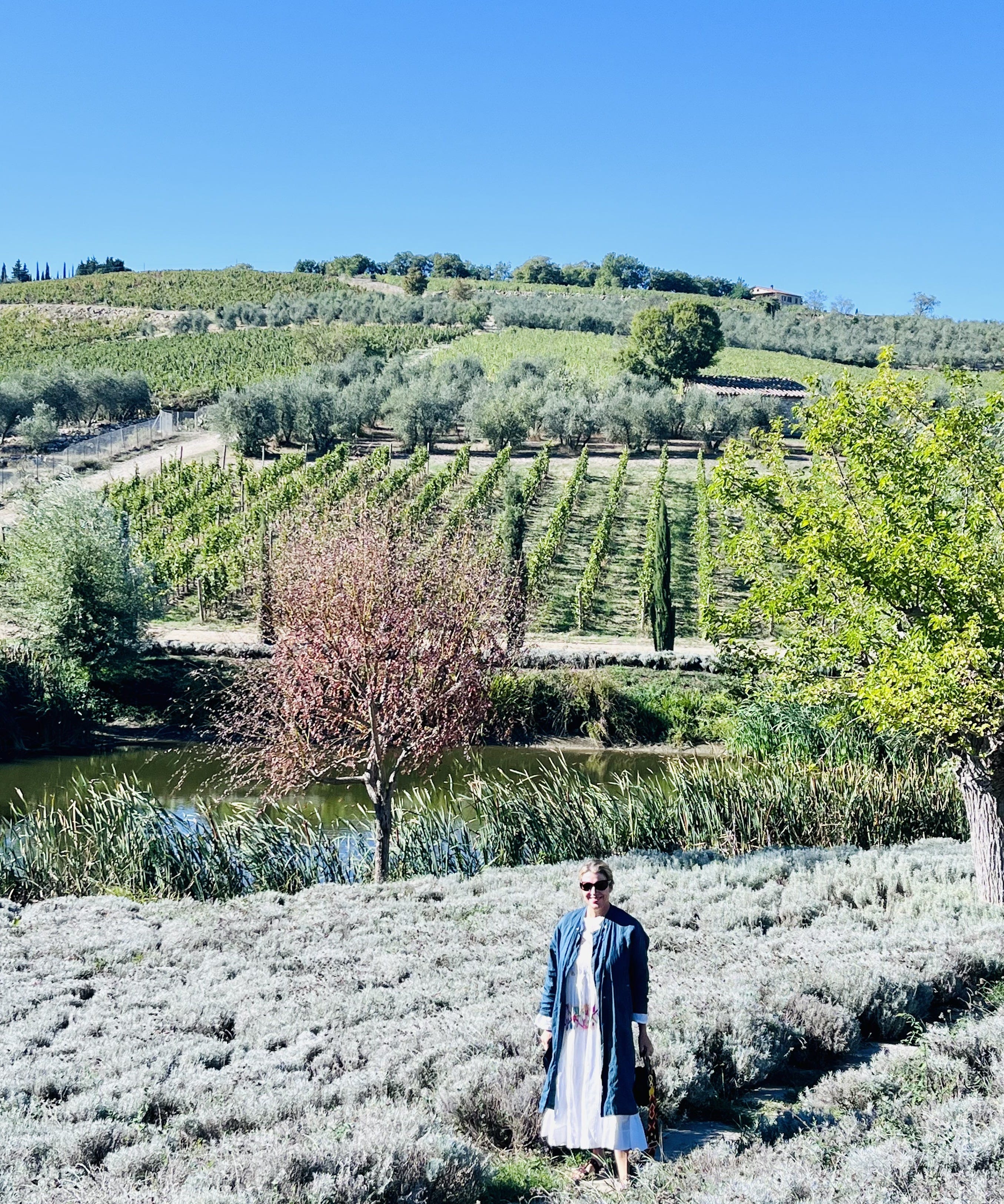
In a field of Helichyrsum Immortelle at Castello di Ama
Playlist-Euro Romantic Dreamer
Part of a Style Archetype Series.
Next: Syllabus of Scent, Reading, and Style Notes.
Mmmmm...anais anais
Beautiful stuff, words and all.
Beauiful Anna! So lush and vivid. Time travel